3V Content Connect Framework For Content Marketing Success
Content marketing was definitely easier pre-2023.
It was a game with a set of strategic rules:
Identify pillars and keywords.
Write content to support those pillars and keywords.
Optimize your content.
Capture backlinks.
Rank.
If you learned the rules, ranking was actually pretty easy.
But content marketing post-2023 feels a bit more like this:

It’s freaking chaos.
For starters, we have the big AI players that can generate content in seconds. Every laptop, phone, and browser is now a publishing machine, making every digital device feel like this:

The gluttonous excess of content makes it challenging to stand out.
What’s more, search is an entirely new experience. We now have:
AI overviews answering basic questions before anyone clicks.
LLMs shaping how people search and discover information.
Zero-click searches on the rise.
Social algorithms that shift constantly.
Rankings that no longer guarantee visibility.
Search happening across platforms like YouTube, Amazon, and Reddit—not just Google or AI tools.
If content marketing has felt like you’ve been navigating a maze without a map. It’s because… well, you have been. We’ve all been reacting in real time to new technology and tools, platforms, and algorithms shifting beneath our feet, and changing search/buyer behaviors.
But enough time has passed to see what’s actually sticking.
Today, we have data. We’re seeing patterns. And we have a clearer sense of what works.
Let’s talk about what’s changed and a solid framework for navigating it.
The Content Connect 3V Framework:
3Vs: Visibility, Voice, and Value.
Here’s what it means.
1. Visibility
Visibility used to mean ranking on Google.
Today, it means something much broader.
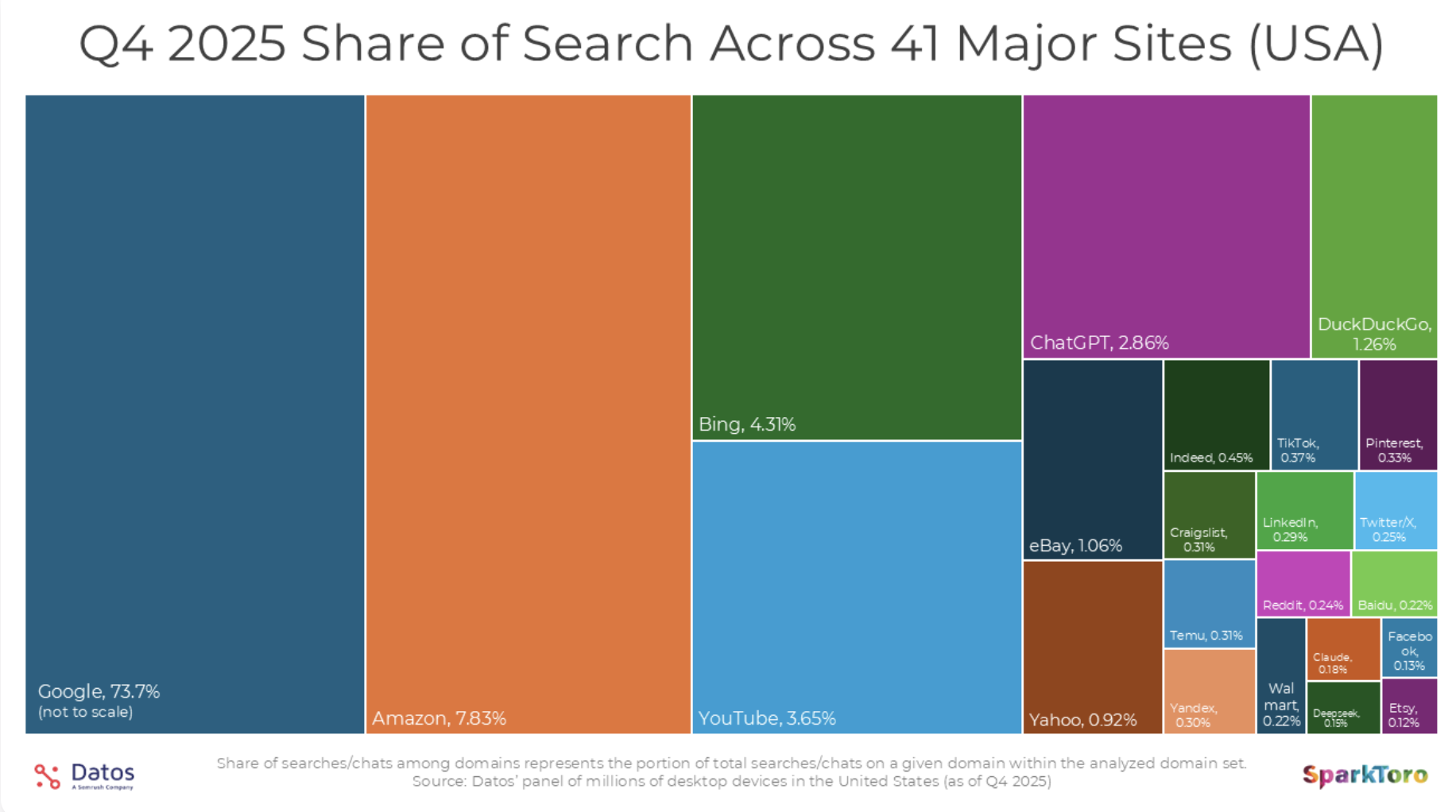
According to SparkToro and Datos research, your audience searches everywhere there’s a search or a prompt bar (not equally across platforms, but still). We now have searches trending on:
Google, still dominating at roughly 73% of searches.
Commerce platforms like Amazon (which captures around 7% of searches).
Social platforms like YouTube, Reddit, and Instagram account for ~5–6% of total searches.
AI tools like ChatGPT, which get a lot of attention but still make up only ~3% of search activity (let that 3% number sink in when thinking about where to budget your visibility efforts).
This is not exactly the “classic SEO” list that used to exist.
Even within Google—which still accounts for roughly 73% of search activity—the game has changed.
On Google alone, there are now multiple layers of visibility:
Paid listings.
Organic listings (traditional blue link rankings).
SERP features like AI Overviews and featured snippets.
Organic rankings still matter—but they’re no longer the only way to be seen. Click-through rates are declining, and more searches end without a click as Google answers queries directly.
Then you have AI Overviews. Research from Ahrefs found that only 38% of pages cited in AIOs rank in the top 10 results—and 37% don’t rank in the top 100 at all.
That’s a major shift. Visibility on Google is no longer reserved for the highest-ranking pages.
And beyond Google, there’s an entirely separate layer of visibility emerging.
AI systems like ChatGPT and others don’t rank pages—they generate answers. Visibility in these systems comes from being cited, mentioned, and reinforced across sources.
Bloom research analyzed hundreds of millions of AI citations and found the following:
Sites mentioned across multiple platforms are 2.8x more likely to appear in AI responses.
Only ~11% of domains show up across multiple AI systems
Brand search demand—not backlinks—is the strongest predictor of AI visibility.
You don’t win by ranking once. You win by showing up across multiple systems.
This means content teams must be:
Covering topics comprehensively, not just targeting keywords.
Building clusters of related content that reinforce each other.
Publishing beyond your blog—in places your audience already spends time.
Treating YouTube, Reddit, and communities as search engines in their own right (and as places where AI pulls info from).
Earning mentions, citations, and distribution.
It’s also worth mentioning that fresh and refreshed content gets more visibility—in organic and AI listings.
The same report shows:
~65% of AI visibility goes to content published within the past year.
~79% goes to content updated within two years.
2. Voice
The second pillar, voice, matters more than ever.
In a world where AI can generate technically correct blog posts in seconds, the biggest differentiator left is how something is written and who is writing it (remember, authority matters in E-E-A-T).
Voice is what makes someone stop scrolling and think:
“This person gets it.”
“I get this person.”
“I like this content.”
“I learned.”
“I’m laughing.”
“These words are making me feeeeeeeel.”
Great writing has always had this quality.
You can recognize writers like Emily Dickinson, Langston Hughes, Hemingway, or Joan Didion instantly because their sentences carry a distinct fingerprint.
Great brand content works the same way. Yes, I’m saying your brand can—and should—have a voice just like a timeless and beloved writer.
Unfortunately, most brands opt for a Soulless, Snooze-Fest, AI-Sounding Voice—the noisy content no one cares about and no one wants
Often, the voice problem starts in the style guide. Any AI-generated style guide can direct writers to be:
“Professional but approachable.”
“Bold yet empathetic.”
But, these directions don’t really help anyone capture your company's voice, and it certainly doesn’t help your company develop a standout voice.
It shows up in the mechanics of how you write—not just how you describe your tone, including:
Sentence structure. How you build sentences. Short and punchy? Longer and layered? A mix of both?
Rhythm and pacing. How your writing feels. Fast and skimmable? Slower and more reflective? Where you pause—and where you don’t.
Word choice. The words you consistently use—and avoid. Clear and direct? Technical? Conversational?
Point of view. Your perspective and level of conviction. Do you take a stance, or stay neutral and safe?
Grammar and mechanics. Do you use fragments? One-line paragraphs? Break rules on purpose? These choices shape how your content reads.
What you choose to say—and what you don’t. What you emphasize. What you ignore. What you refuse to sound like. This is where voice really takes shape.
It can go deeper, too.
Does your voice include?
Subject matter expertise. Are you saying something informed, or just repeating what’s already out there?
Original data or insights. Are you bringing something new to the conversation?
Cultural fluency. References, memes, or moments that make your content feel current and human.
Clear opinions. Do you take a stance, or stay safely in the middle?
Real examples. Do you show how things work in practice, or keep it abstract?
When developing a style guide, make it easy for your writers to capture your unique voice. Include:
Clear examples of how you sound
Examples of what you deliberately avoid
Patterns writers can imitate
Guidance on how to handle common scenarios (educational, opinion, storytelling)
The ultimate litmus test: If someone could remove your brand name from an article and nobody would know what company wrote it, your voice probably isn’t strong enough yet.
3. Value
A lot of brands publish content.
Far fewer publish content that helps their intended audience.
Value is the third pillar because it’s the one that makes the other two matter.
Visibility without value just creates traffic that bounces.
Voice without value is style without substance.
A great way to think about value comes from Clayton Christensen’s Jobs to Be Done framework.
People don’t read business content for the content itself.
They “hire” it to do something.
Maybe the job is:
Help me understand something confusing
Help me explain this to my boss
Help me avoid making a bad decision
Save me three hours of research
If your content doesn’t clearly do a job, it probably isn’t very valuable.
This is also where buyer psychology matters.
Research from Daniel Kahneman and Amos Tversky shows that people are roughly twice as motivated to avoid losses as they are to pursue gains.
Which explains why headlines like:
“5 Content Mistakes Quietly Killing Your Traffic.”
often outperform:
“5 Ways to Improve Your Content Strategy.”
Both might contain the same advice.
But one speaks directly to the reader’s fear of getting something wrong.
Putting the 3Vs together
The 3V framework is simple, but surprisingly powerful.
Before publishing any piece of content, ask three questions:
Visibility. Will the right audience find this?
Voice. Does this sound like us, or like every other article online?
Value. Will the reader leave knowing something useful or able to do something new?
If all three are working together, the content has a much better chance of standing out—even in a world producing 181 zettabytes of data per year.
If you enjoy this content, subscribe to the Content Connect newsletter by Ashley R. Cummings.