The content brief is broken. It’s optimizing for an internet search experience that no longer exists… here’s the fix
Content marketing is in a weird place right now.
Every day, there are new reports, articles, podcast clips, LinkedIn posts, newsletters, studies, and data points all telling us some version of the same thing: search is changing.
The way Google and LLMs surface results (and the signals they collect) is volatile. Search itself is fragmenting across social media, LLMs, forums, and traditional engines. Traffic patterns are changing, and so are consumer behavior and trust.And with all these changes, we still don’t quite have a neat framework, polished playbook, or proven system that marketers can follow to fully optimize content for the search experience.
New insight, strategy ideas, and data are coming to us in fragments for us to piece together.
And despite all the evidence that discovery, search behavior, and content consumption are evolving, many brands still cling to strategies built for an older version of the internet.
I see it often in the briefs that come across my desk.
Most briefs and content workflows still operate as if search works the way it did five years ago.
Usually, these briefs include a version of this:
A primary keyword
A few secondary keywords
A generic, often AI-generated TOFU outline
Surface-level E-E-A-T requirements
A list of competitor headings pulled from the SERP
Basic search intent notes
Word-count requirements
Vague instructions to add expertise
FAQ requirements
I suspect sticking to this relic of a content brief (and an overinvestment in scaled AI content) is one reason we’re seeing gobs of TOFU content that lacks the 3Vs that are essential to good content marketing:
Voice
An abundance of online content is now a snooze to read and a snooze to write. It is completely interchangeable with competitor content. There is no perspective, no personality, no tension, no editorial identity. It could absolutely be generated by AI.
It is more noise in an already overcrowded internet. It’s forgettable.
Value
It does very little to genuinely help the customer. It rarely offers original insight, layered thinking, or meaningful expertise. In many cases, it speaks below the audience’s actual level of sophistication.
The result is throwaway content that exists primarily because a keyword tool suggested it should exist.
Visibility
Maybe it ranks for a while. Maybe it captures some search traffic before the SERP changes again, or an AI Overview absorbs the click entirely.
But increasingly, this kind of content struggles everywhere else where visibility now matters. It’s absent from:
LLM outputs and AI-generated summaries
Reddit conversations and community-driven recommendations
LinkedIn discussions and thought-leadership ecosystems
YouTube explainers, reviews, and industry commentary
The broader discovery ecosystem where people are actually validating information, forming opinions, and building trust
In other words, it is technically “optimized” while being strategically invisible.
Continuing to use this old content marketing strategy and related brief is why search traffic and brand visibility look like this (actual footage):

So, what’s the fix?
Well, to start out, it’s doing the hard work.
Step one starts with understanding what’s changing. Step two is testing new strategies. And step three is helping team members outside of strategy roles — writers, editors, and contributors — adapt through education and updated briefs.
What’s changing in the world of search & content
1. People are searching on search engines & AI platforms
An important corrective in the research right now comes from the 2026 State of Search report from Datos, built on large-scale clickstream data from real users across the US, EU, and UK.
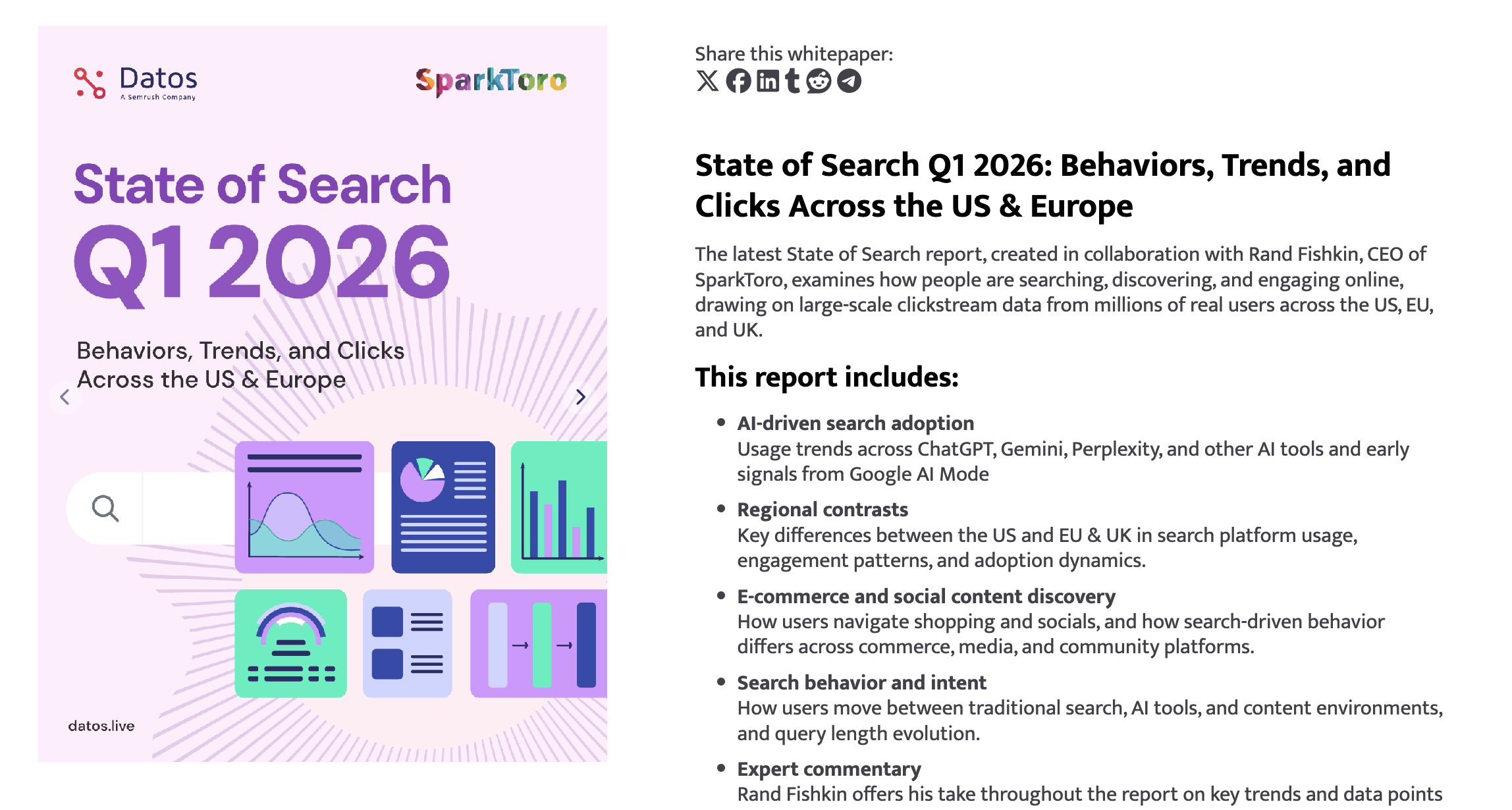
One finding: Google recovered to 94.3% desktop search share in the US by March 2026. Zero-click searches (the metric that's become shorthand for "the open web is dying") actually fell from 24.5% in December 2025 to 22.4% in March 2026. Organic click share rose to 44.9%.
AI tools, for all the attention they receive, still account for less than 2% of total desktop web visits.
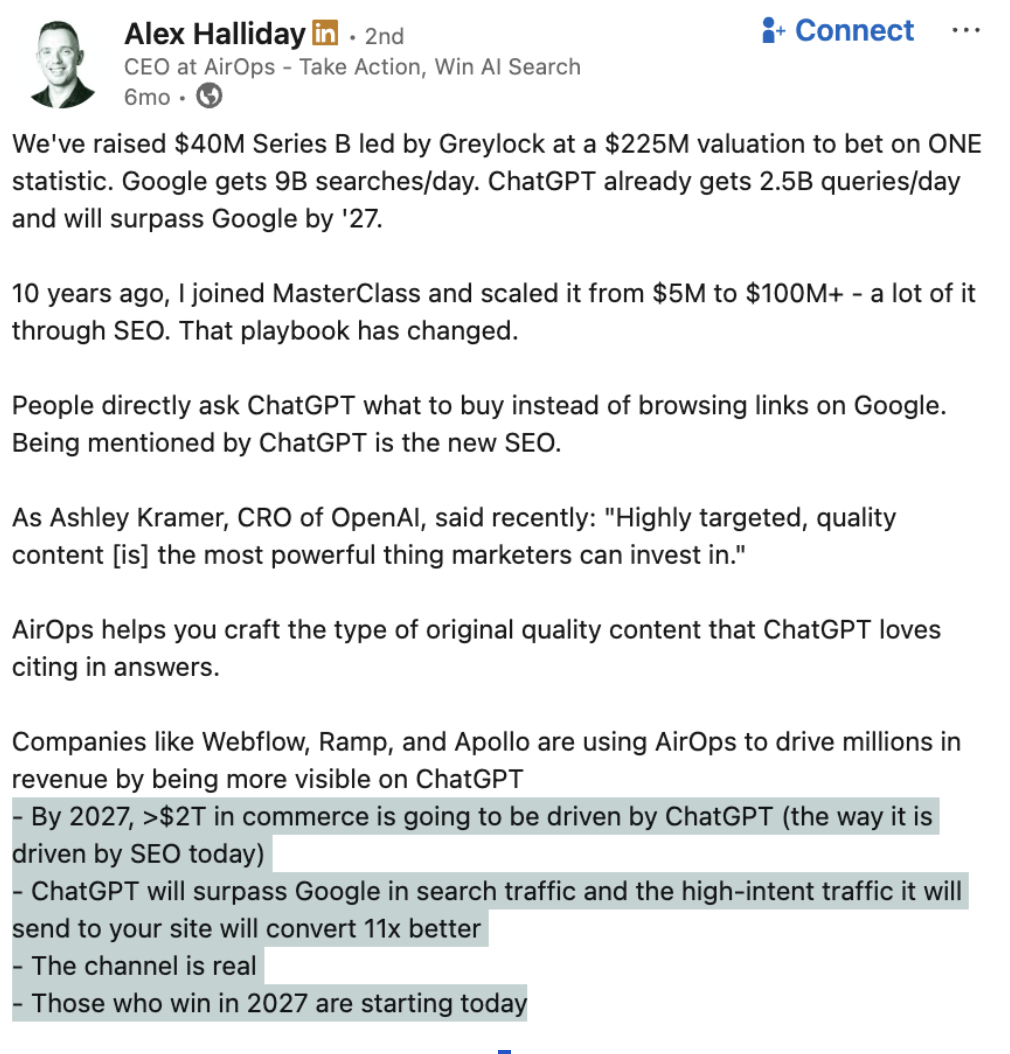
Some experts, like the CEO of AirOps, Alex Halliday, offer different projections. He asserts that by 2027, ChatGPT will surpass Google in search traffic.
This matters because content strategy gets influenced by overreaction in both directions.
If your team concludes that Google no longer matters and shifts investment away from organic search (note: organic search looks a lot different now than it used to), you're making a decision the actual data doesn't support. If you conclude that AI search is irrelevant because its share is still small, you're ignoring where the structural signals are pointing.
The right search optimization frame is a dual-track model. One track protects and expands visibility in traditional search (however volatile it may be). The other prepares content for AI-mediated environments where the rules of visibility differ. Both are real. Neither is optional.
2. Information agents are searching the web
At Google I/O 2026, Google announced what it called the biggest change to search since the search box debuted 25 years ago. The new experience introduces agentic capabilities, which are "information agents" that work in the background 24/7, synthesizing findings on a user's behalf.
This means search won’t look like it has in the past, with 10 blue links to click after a keyword search. Many searchers will tell an agent what to monitor and receive synthesized updates with links they can explore if they choose.
As TechCrunch put it: "searching the web will increasingly be performed by AI agents rather than humans."
What does this mean for content? The click is no longer guaranteed. Your content may be read, summarized, and acted on without a single visit to your site. The agent becomes the intermediary between your content and your audience, which means content that exists only to rank for a keyword, with nothing distinctive to say once it gets there, has almost no reason to exist at all.
Note: I’ve seen about 100 versions of what Google will look like since Google I/O 2026. I’m going with the version I believe is most probable/accurate for now.
3. We have to create for agents and humans
The Economist's VP of Generative AI, Josh Muncke, told Digiday their publication is preparing for "a world with two versions of the web,” one that’s optimized for rich human reading experiences, another where agents want clear structure, questions and answers, and ideally plain text.
The Economist is already building parallel versions of its marketing content: one designed for humans, one stripped back and Q&A-structured for agents.
The logic: AI intermediaries are increasingly acting on a user's behalf before that user ever arrives at a homepage or types into a search bar.
But even in a world shaped by agents and AI discovery, humans are still the audience that matters. Visibility means very little if the actual person on the other side feels nothing, learns nothing, trusts nothing, or remembers nothing. An LLM can surface your content. It cannot force someone to care about it.
That’s part of the danger of AI-powered scale. It’s now incredibly easy to plug into a scaling tool and flood the internet with structurally optimized content built for discoverability. And yes, some of it may earn visibility. Some of it may even get surfaced by agents.
But visibility alone has never been the point of content marketing.
The “Value” part of the 3V framework matters more than ever now. If content doesn’t offer real insight, perspective, usefulness, originality, or a reason for a human being to stay engaged, then scale simply produces more forgettable content faster. And this type of scale gets annoying fast.
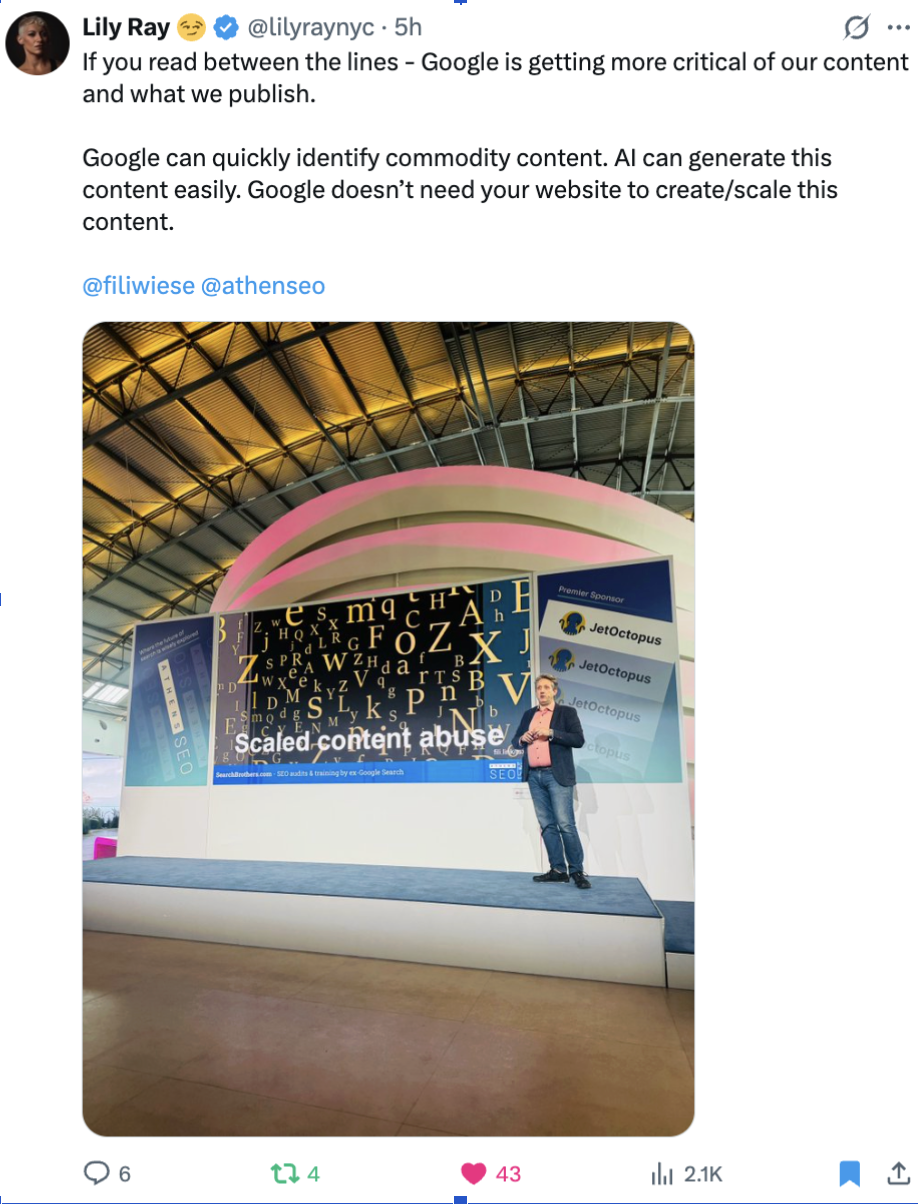
Google talks about this often. In its guidance around helpful content and quality evaluation, Google repeatedly draws a line between commodity content — interchangeable, generic information created primarily to capture traffic — and content that demonstrates originality, experience, perspective, and genuine value to readers.
Maybe that’s the real test now:
Would a real person still care about this if visibility were guaranteed?
4. People use different search tools for different purposes
Here's a behavioral finding that most content strategy conversations miss entirely. Nielsen Norman Group research published in February 2026 found that users choose AI tools to explore and synthesize information, but they still rely ontraditional search when accuracy and trust are critical.
A reader who finds your content through an AI summary is in exploration mode. They're orienting, comparing, building a mental model.
A reader who clicks through from a traditional search result is in verification or buy mode. They're checking a specific claim, evaluating a source, deciding whether to trust you.
In my own experience as a searcher, AI mode/LLM search is enough for quick answers, but I don’t remember (or care) who/where the content came from. When I want a deep answer, I look beyond AI visibility. I’ll search until I find content that stands out, and I’ll typically continue my search across platforms looking for expert insights. This search pattern is how I learned about Lily Ray and Aleyda Solis, and why I subscribe to their newsletters and social accounts.
This behavioral shift matters in a zero-click environment and should inform your brief.
Rand Fishkin and Amanda Natividad have argued that modern content increasingly has to deliver value before a click ever happens. AI summaries, search snippets, Reddit threads, LinkedIn posts, TikTok explainers, and social search results are all becoming discovery layers through which users can get enough information to move on without ever visiting a website.
The content itself—across every discovery surface—has to be helpful/interesting enough that people remember the source (e.g., your name or your company). It should stand out enough that they later search for your brand directly, subscribe to your newsletter, look up your framework, follow your perspective, or intentionally seek out more of your work.
In a fragmented search environment, memorability and trust matter as much as (or more than) rankings—and that should fundamentally shape the modern content brief.
5. AI platforms look beyond Google — and LinkedIn matters more than most marketers realize
Research synthesized by AEO strategist, Kaleigh Moore, drawing on data from Profound and Semrush, gives us a clearer view of where AI systems surface information for professional and B2B-style queries.
LinkedIn now appears heavily in AI-generated answers for professional queries. Profound data, cited by Moore, found LinkedIn appeared in 14.3% of ChatGPT Search responses and 13.5% of Google AI Mode responses, putting it ahead of Wikipedia in that dataset. The content getting cited also wasn’t necessarily viral. Moore notes that the average cited LinkedIn post had only 15–25 reactions.
Patterns associated with citation include original content, substantive long-form posts or articles, consistent publishing from named experts, and clear, citable claims. Semrush found that roughly 95% of cited LinkedIn content was original rather than reshared, and Moore has highlighted research showing LinkedIn articles in the 500–2,000-word range account for a large share of AI citations (but, again, emphasizes that it’s helpfulness—not word count range—that matters).
The big takeaway is that AI systems increasingly evaluate distributed expertise signals across the open web—not just what ranks in Google.
That idea applies to more than LinkedIn, too.
Krista Doyle’s analysis shows that platforms like Reddit are becoming increasingly important because AI systems learn from real community discussion, not just brand-owned content. The visibility that emerges there is rarely driven by aggressive optimization. It comes from consistent participation, demonstrated expertise, usefulness, and genuine trust built inside communities over time.
In other words, AI systems increasingly reward signals that look less like traditional SEO manipulation and more like authentic reputation.
Google is reinforcing this direction, too. In its guidance around helpful content and AI search, Google warns against inauthentic mentions and low-value tactics created primarily to manipulate visibility.
At the same time, the systems surfacing content are becoming far more sophisticated.
According to Mike King, many AI search systems now operate through agentic retrieval. Instead of retrieving one set of results and generating an answer, they may break a query into multiple sub-queries, retrieve information repeatedly, compare passages against competing sources, and filter results through reranking and reflection stages before generating a final answer.
That raises the bar for content. A strong page isn’t enough if the individual passages are vague, stale, generic, or hard to extract. Content now has to compete at the passage, claim, expertise, and trust level—not just the page level.
6. Freshness is a citation signal
It’s worth mentioning that freshness plays a huge role in what content appears in search results. Seer Interactive analyzed 5,000+ URLs across ChatGPT, Perplexity, and AI Overviews and found that65% of AI bot hits targeted content published within the past year, 79% from the last two years, and 89% from the last three years.
The old evergreen content model of "write it once, optimize it once, let it rank forever" is incompatible with how AI retrieval systems (and search engines) evaluate sources.
A brief that doesn't account for a content refresh cycle is producing content with a built-in expiration date for AI visibility.
What this means before we get to the brief
I’m not sure anyone has formally studied the relationship between brief quality and content performance in this new environment. I haven’t found published research connecting brief structure to AI citability, cross-platform visibility, or the kind of depth that earns clicks after an AI summary. That gap is part of what this piece is trying to close.
What the research does make clear is the shape of what content needs to do now. It needs to be found—across Google, across AI systems, across the platforms people use to validate what they've already read. It needs to say something specific enough to be citable and deep enough to be worth clicking. It needs a voice distinctive enough that an AI summary can't fully replace it. And it needs to be fresh enough that retrieval systems still consider it current.
The brief is where all those requirements either get built in from the start or aren't built in at all.
So let's build a better one.
The 3V Content Brief, made for marketing in 2026
The old brief was built around a keyword and a SERP. Everything else—the outline, the structure, the word count, the FAQ section — followed from that starting point.
The new brief starts somewhere different: with the reader, the decision they're facing, and the specific thing this piece of content will say that’s new, interesting, and helpful.
This changes what the strategist has to figure out before briefing a writer, what the writer has to produce, and what the content has to do to earn its place in a crowded, AI-mediated discovery environment.
Here's what each section of the new brief addresses and why it matters:
The reader. This is not a persona like "marketing managers aged 25–45." It’s a real description of who this person is, what they already know, and how sophisticated they are about this topic. The brief should name what the reader has probably already read, tried, or concluded, so the content can meet them there instead of starting from scratch. Content that speaks below its audience's actual level gets ignored. Content that assumes too much gets abandoned. The brief is where that calibration happens.
The job. What decision is this content helping the reader make? What are they trying to figure out, evaluate, or do? This is more specific than search intent. "Understand what content marketing is" is intent. "Decide whether to rebuild our content strategy around AI search or stay the course" is a job. Content written for a job has a direction. Content written for an intent category often doesn't.
The original angle. This is the most important field in the brief and the one most often left blank. What does this piece say that nothing else already says? It could be original data, a counterintuitive position, a framework, a specific example from real experience, or a synthesis of research that hasn't been put together this way before. If the writer can't answer this question, the content will be commodity by default. The brief has to force the answer before writing starts.
The voice direction. In a world where AI can generate a technically correct blog post in seconds, voice is one of the last true differentiators a brand has. But most briefs treat voice as an afterthought — a line that says "professional but approachable" or "write like our brand" — and hand it to a writer who has no idea what that means.
Voice shows up in the mechanics of how something is written: tone, sentence rhythm, word choice, whether the piece takes a stance or hedges, what it refuses to sound like, and what it's willing to say that a competitor wouldn't. A strong voice brief provides the writer with enough specific direction to make real choices at the sentence level. It also invites a writer to write in their own voice.
A unique voice is always more interesting to an audience than a brand guide. It’s why we opt for creative non-fiction over the Encyclopedia. It’s why—even if we have a favorite author—we read books written by different people.
The insights in this section are meant to force the kind of thinking that produces content with an authoritative and editorial identity to produce content that, even if you removed the brand name, someone would still recognize as yours.
The value test. Value is whether a real person, with a real problem, walks away better equipped than when they arrived.
Clayton Christensen's Jobs to Be Done framework is useful here: people don't read business content for its own sake. They hire it to do something:
Help me understand this
Help me explain this to my boss
Help me avoid a costly mistake
Save me three hours of research
Help me make a decision faster
Give me language, insight, or evidence I can actually use
If the content doesn't do a specific job, it probably isn't valuable, regardless of how well it's structured or how thoroughly it covers the keyword. The brief should explicitly name the job and what the reader walks away with.
The structure guidance. Yes, we want voice in every piece. But we still need structure (for visibility). The brief should specify:
How many major sections the piece should include
Roughly how long each section should be
Where the citable claim or key takeaway should appear (ideally in the first two sentences of a section)
What the heading hierarchy should accomplish
Which sections need depth, examples, analysis, or proof points
Where scannability and extractability matter most
Research above suggests sections of roughly 120–180 words with clear H2/H3 structure are often easier for AI systems to extract and interpret than large walls of prose. That’s not a reason to write mechanically. It’s a reason to write clearly.
The agent brief. The brief should include two or three questions the content needs to answer clearly enough that an AI system could cite a specific passage in response. This forces the writer to think about extractability not by hacking the structure, but by ensuring the content contains direct, citable answers rather than vaguely gesturing toward them. If the content cannot answer those questions cleanly, it probably is not specific enough yet.
Subject matter expertise. AI systems are increasingly good at identifying whether a piece of content reflects genuine expertise or competent summarization of other sources. Google's E-E-A-T guidance has always included experience — the first E, but most briefs have never operationalized it. The brief needs to name who the expert is, what specific experience they're drawing from, and how that experience shows up in the content. Not "add expert quotes." Not "write in an authoritative tone." Specifically: who has done this, seen this, or built this — and how does their firsthand knowledge change what this piece can say that a generalist writer synthesizing existing content cannot?
This matters beyond E-E-A-T signals. Research on AI citations consistently shows that content attributed to named experts with demonstrated credentials is more likely to be surfaced than anonymous or purely brand-attributed content. The person behind the content is increasingly part of the content's authority signal.
New data. The single fastest way to make a piece of content non-commodity is to put something in it that didn't exist on the internet before you published it. Original research, a proprietary survey, client data (anonymized where needed), internal benchmarks, or even a structured collection of firsthand observations — any of these give AI systems, journalists, other writers, and readers a reason to cite you specifically rather than a dozen other sources covering the same topic. The brief needs to ask this question directly: what new information does this piece contribute to the conversation? If the answer is nothing, that's a brief problem, not a writing problem.
Digital Bloom's research found that branded web mentions are among the strongest predictors of AI citations, and original data releases are among the most efficient ways to generate those mentions. A single survey with meaningful findings, pitched to trade press and distributed across channels, can produce citations that compound over time in ways that structural optimization alone never replicates.
Original storytelling. Data without narrative is a spreadsheet. Expertise without a story is a credential. The most enduring content in any industry combines both. Ot makes an argument through evidence and makes that argument human through story. The brief needs to identify what story this piece is telling: a client situation, a mistake and what it cost, a pattern observed across dozens of engagements, a decision the author made, and why.
This is also what AI summaries struggle most to compress. A specific, detailed story from a named expert carries information (texture, context, consequence) that a generative summary flattens. Readers who want the full story have to click. That's the intent gap that original storytelling creates and generic content never does.
The distribution plan. Where content lives and where it travels are two different questions, and the brief needs to answer both before a writer starts. Most briefs name a destination—the blog, the resource center — and stop there. But in a fragmented search environment, a piece of content that only ever lives in one place is working at a fraction of its potential visibility.
LinkedIn deserves specific attention here. As Profound data shows, LinkedIn is now the number one cited domain for professional queries across every major AI platform. That means LinkedIn distribution is an audience engagement play AND a citation play. A substantive LinkedIn article or post, adapted from a blog post and published by a named expert, creates a distinct AI-visible signal that reinforces the original piece.
Reddit requires a different posture entirely. The brief should identify whether the topic has active Reddit communities discussing it, and whether there's a legitimate, non-promotional way to contribute. A genuinely useful comment in a relevant thread, from someone with actual expertise, is worth more for AI visibility than most things you can do on your own domain.
Internal SMEs are a distribution channel most brands underuse. The brief should name which subject matter experts are likely to share, comment on, or amplify this piece as a signal to the writer about whose voice and experience should be woven into the content from the start. An SME who contributed to a piece is far more likely to share it than one who's handed a link and asked to promote it. And when named experts with established LinkedIn presences engage publicly with the content, it compounds the citation signal the research describes.
The freshness plan. When does this need to be reviewed? What data or claims are time-sensitive? Who owns the refresh? A piece published without a refresh plan is a piece that will become a liability as soon as the research it cites ages out of AI retrieval windows.
The 3V Content Brief
Publication/brand:
Topic:
Target publish date:
Writer:
Strategist:
Editor:
Optimization tool:Part 1: The reader
Who specifically is this for?(Not a persona. Describe their actual sophistication level on this topic. What have they already read, tried, or concluded?)
What's their job or decision?(What are they trying to figure out, evaluate, or do? Be specific. "Understand content marketing" is not a job. "Decide whether to rebuild our content strategy before Q3" is.)
What do they need to believe by the end?(One sentence. The shift in thinking this content is trying to create.)
Part 2: The angle
What is the original angle?(What does this piece say that nothing else already says? Name the data, experience, framework, or perspective that makes this non-commodity.)
What commodity version of this content already exists?(Name 1–2 existing pieces this must be better than.)
What does this piece NOT do?(What generic content trap does the writer need to avoid?)
Part 3: Voice
What is the brand or author's distinct point of view on this topic?(Not what the industry says. What do YOU (or the SME you’re working with) say, and why does your/their experience or perspective give you the standing to say it?)
What would a competitor never say about this topic, but you would?(Name the opinion, the counterintuitive take, or the uncomfortable truth this piece is willing to put on record.)
What has the author seen, built, or experienced firsthand that informs this piece?(Specific. Not "years of experience in the industry." What actual situation, client, mistake, or observation does this draw from?)
What does this piece refuse to sound like?(Name the content trap or the generic version of this article that already exists. What makes this nothing like that?)
If someone removed the brand name from this piece, what would make it still recognizable as yours?(Sentence rhythm, recurring phrases, the topics you always connect, the things you always push back on — name them.)
Voice direction for the writer:(Tone, sentence length, stance, formality, use of first person, what to avoid. Include a before/after example if possible.)
Part 4: Value
What is the reader's specific job?(What are they trying to figure out, evaluate, decide, or do? One sentence.)
What does a human reader walk away with?(Name the specific insight, framework, decision, or shift. Not "awareness of our brand." Something a person could act on, explain to someone else, or apply tomorrow.)
What mistake does this content help them avoid?(Loss aversion drives engagement. Name the specific, costly error this piece helps the reader not make.)
What would they have to do or read to get this elsewhere?(If the answer is "read three other pieces and synthesize them yourself" — that's the gap this fills. Name it.)
What level of sophistication does the reader bring?(Beginner / intermediate / advanced — and specifically what that means for what to include, what to skip, and what to never condescend about.)
Part 5: Structure
Recommended sections:(List the major sections with a one-line description of what each one does.)
Citable claim placement:(What are the 2–3 most extractable, citable claims in this piece? Where do they appear?)
Heading guidance:(H2s for major themes, H3s for specifics. Sections should be roughly 120–180 words for extractability.)
What the intro must do:(The first 1–2 sentences should contain a self-contained, citable claim. What is it?)
Part 6: The agent brief
How to find the right questions:
Run the topic in ChatGPT, Perplexity, Claude, and Google AI Mode. Where the answer is vague, hedged, or generic — that's a citation opportunity. Look at People Also Ask in Google for conversational phrasing. Read Reddit threads on the topic for questions the community debates without resolving. Ask your SME what they get asked most in sales calls, client meetings, or DMs.
What three questions should this content answer well enough to be cited?
For each question, draft the citable answer:
(Lead with the direct claim. Support it after. No "it depends" openers. No "there are many factors." The claim first, then the reasoning. Roughly 50–100 words per answer — specific enough to stand alone as a cited passage.)
Answer 1:
Answer 2:
Answer 3:
Extractability check: (Read each answer in isolation. If it showed up as a pull quote with no surrounding context, would it still make sense and be useful? If not, it needs to be more self-contained.)
Commodity check: (Could an AI system have generated this answer from existing sources without any firsthand expertise or original data? If yes, it needs a more specific angle, a real example, or a data point that only you have.)
Part 7: Subject matter expertise, new data, and original storytelling
Who is the subject matter expert?(Name them. What is their specific, firsthand experience with this topic? What have they done, built, seen, or measured that a generalist writer synthesizing existing content hasn't?)
How does their expertise show up in the content?(Not just quotes. Where does their firsthand knowledge change the argument, the example, or the conclusion?)
What new data does this piece contribute?(Original survey findings, proprietary benchmarks, client data, structured observations, or firsthand research. If none: is there a way to generate something before this publishes?)
What is the original story?(A specific situation, decision, failure, or pattern from real experience. Name it here so the writer knows to build toward it — not add it as an afterthought.)
External sources to reference:(Links, reports, expert quotes. Flag anything that needs verification or attribution.)
What does this piece cite that makes it worth citing in return?(The brief should be able to answer this before a word is written.)
Part 8: Distribution (Don’t make your writer do this, too, or pay them more!)
Primary destination:(Where does this piece live? Blog, resource center, help docs, landing page.)
LinkedIn:(Is there a LinkedIn adaptation? Who publishes it — brand page or named individual? Is it a direct excerpt, a reframe, or a standalone argument that links back? Target publish date.)
Reddit:(Does this topic have active Reddit communities? Name them. Is there a legitimate, non-promotional way to contribute? Who on the team has the credibility to show up there authentically?)
Newsletter:(Is there a newsletter version or excerpt? Which issue? What angle does it take for that audience?)
Other channels:(YouTube companion, podcast mention, partner distribution, paid amplification. List what's planned and who owns it.)
Internal SMEs who will share or engage:(Name specific people — not job titles — who are likely to share, comment on, or amplify this piece. What's their LinkedIn presence? Have they been looped in before publication? Did their expertise or experience shape the content?)
External SMEs or collaborators:(Any outside experts, partners, or contributors whose involvement makes them likely to share? Were they quoted, consulted, or credited?)
Community presence:(Beyond Reddit — are there Slack communities, Discord servers, industry forums, or LinkedIn groups where this topic is actively discussed? Name them. Who participates there on behalf of the brand?)
Distribution owner:(Who is responsible for executing this plan after publication?)
Part 9: Freshness
Refresh date:(When does this content need to be reviewed?)
Time-sensitive claims:(Which data points, statistics, or references have a shelf life? Flag them here so the refresh owner knows where to start.)
Refresh owner:(Who is responsible for updating this piece?)
Approval
Strategist sign-off:
Editor sign-off:
Published URL:
Good content marketing just got a lot harder
Content marketing—even with AI at our disposal—got harder than it’s ever been. If you adopt a new brief and approach to content, you’ll create something that matters. And remember—content that matters is hard to create.
Pay your strategists, writers, and editors more.
Did you like this? Subscribe to Content Connect for regular updates.